CONTACT
The firm "Ana Rico" has a motto:
"THE CLIENT IS THE FIRM'S MAIN PRIORITY"
Don't hesitate to call or write to us so we can offer you... personalized service , in:
Mobile: (+34) 619 76 40 73
Email: info@anarico.net
"STRIVING EVERY DAY TO CONTINUE,
AMONG THE BEST"


RESOURCES AND INNOVATION FROM ORGANIC SCIENCE Foundation
Project organization: merging Science, Innovation and Design (R&D)
INNOVATION + DESIGN (R&D) PROJECTS
ENERGY PROJECT, SPAIN
COMPLETED TODAY
The solar sculptures I present are the result of extensive research,
to provide solutions to the challenge of various current problems,
uniting science, technology, art and rescuing local Spanish craftsmanship,
in order to verify that these methods can be implemented as a routine process,
and thus offer society different sustainable devices that protect the planet.
INVESTIGATION
1. TRADITIONAL KNOWLEDGE, CONTEMPORARY SCULPTURE AND ENERGY
1.1. TRADITIONAL KNOWLEDGE: CULTURAL IDENTITY
Traditional knowledge constitutes the core of identity and cultural heritage of today's progressive society, a reflection of the evolution of humanity. Therefore, our cultural identity must be preserved through appropriate policies, and traditional and popular crafts must be safeguarded.
Figure 1
Esparto grass field

Note. Esparto grass plant.
[Photograph], by Ana Rico, 2023.
Figure 2
Esparto grass warehouse

Note. Material: esparto grass.
[Photograph], by Ana Rico, 2023.
Figure 3
Traditional knowledge of esparto grass

Note. Working with esparto grass.
[Photograph], by Ana Rico, 2023.
Furthermore, more sustainable environments are being created in cities, more connected to plants through the materials from which objects are made. We are nature and have that connection to the forest, so these artisan designs offer a way to reconnect with our essence. Driven by knowledge of environmental management from rural areas, urban spaces are becoming more environmentally friendly, achieving the Sustainable Development Goals (SDGs) to curb environmental degradation. Therefore, strengthening the transmission of traditional knowledge is essential for the sustainability of large cities , promoting better use of local resources and reducing pollution through improved waste management.
The condemnatory statements regarding the systematic degradation of these traditions must be conveyed through action, across various contemporary disciplines, to promote and become models and benchmarks of the indigenous cultural heritage of peoples, countries, and regions.
Figure 4
Esparto grass space. Day.

Note. Interior architecture of esparto grass . Day.
[Illustration], by Ana Rico, 2023.
1.2. CONTEMPORARY SCULPTURE: FUNCTIONAL
One way to foster cooperation in the defense of traditional knowledge could be to create an encounter with the Fine Arts, which can be integrated not only with local crafts but also with industrial machinery and the latest scientific discoveries, to offer an innovative service to the community and, moreover, empower the traditional knowledge that identifies each people through their popular culture. Walter Gropius, founder of the Bauhaus School, proclaimed in the 1919 Manifesto: “Today the arts exist in isolation from which they can only be rescued by the conscious and cooperative effort of all artisans […]. The ultimate, though distant, goal of the Bauhaus is the unified work of art…”.
Therefore, the Fine Arts, through their traditional pillars of creation, such as painting or sculpture, among others, can achieve a functional nature, uniting different disciplines, to achieve a new industrial society, respectful of natural resources, and with the sole purpose of protecting and ensuring the survival of the planet.
Figure 5
Esparto grass space. Night.

Note. Interior architecture of esparto grass . Night. [Illustration], by Ana Rico, 2023.
Figure 6
Founder of the Bauhaus School

Note. Walter Gropius.
[Photograph], library, 2023.
1.3. ENERGY: SUSTAINABLE
1.3.1. SUSTAINABLE DEVELOPMENT
The world is plagued by several problems; sustainable development is paramount in current progress, but as long as the population does not have access to adequate and clean energy, we will not be able to face our main problem, climate change, since the biggest polluter in the developing world is not industry, but the misuse of land, deforestation and the burning of charcoal.
Figure 7
Tree felling

Note. Adapted from The British renewable energy company that is cutting down forests in Canada [Satellite photograph], by PLANET LABS PBC, 2022, BBC https://www.bbc.com/mundo/noticias-internacional-63121074.
TREE FELLING
Primary forests are enormous expanses of forest that occupy a quarter of the world's forest area; the rest of the forests have been deforested by human activity.
Faced with the economic giant that moves billions of euros to promote different types of exploitation, in the end it doesn't matter what type of business it is, even if it devastates natural forests that have taken thousands of years to grow, rare primary forests of great environmental importance.
Through illegal logging, these forests are turned into pellets, which are burned to generate electricity. Burning wood produces more greenhouse gases than burning coal. Furthermore, old-growth forests are where large amounts of carbon are stored.
An old-growth forest retains much more carbon than replanted trees; for this reason, we must be strict with sustainability standards and protect all the planet's primary forests from any kind of exploitation.
1.3.2. ENERGY POVERTY
Ending energy poverty saves lives and offers a future for humanity. Therefore, merging contemporary sculpture with the traditional craft of esparto grass weaving and the latest clean energy innovations can improve the quality of life and reduce pollution, enabling us to address climate change and solve the problem through solar energy, both in emerging countries and in impoverished areas.
2. ENERGY PROJECT
2.1. MERGING ART, CRAFTSMANSHIP AND SCIENCE
Furthermore, the key to the fusion of art, craftsmanship, and science lies in these contemporary sculptures, as they offer a comprehensive rethinking of design to achieve a more sustainable society, where the material base is ecological and natural, made from fibers obtained from rural environments of certain plants belonging to the grasses, used for thousands of years. This extraction is a continuation of these ancestral traditional crafts and respectful of the territory.
As Robert Smithson, the most representative artist of Land Art, reminds us, “I think most of us are very aware of the scale of geological time, of the great dimension of time that has been dedicated to sculpting matter…,” just as geology sculpts the Horcajo Mountains, these works are sculpted in an open space, to experience how esparto grass and rush are transformed through traditional knowledge into contemporary sculpture. Exhibited outdoors, these works are immersed in the flow of imprecise seasonal time.
Through this sculptural production, the art-craft relationship is revalued, where popular knowledge is implemented with current technological processes of scientific innovation, to reflect a new satisfaction of vital human needs, such as in this case, sustainable light, offering as a result a functional artistic-craft project of scientific innovation.
2.2. SCULPTURES OF THE PROJECT: "THE ECOLOGICAL ERA, THE RETURN TO THE EARTH"
Figure 8
Trees
2.2.1. INTELLIGENT NATURE THROUGH FORMS
LIVING BEING: LAND AND SEA PLANTS
These handcrafted esparto grass sculptural structures, exposed to the outdoors and inspired by the organic forms of plants, blend into the rhythm and harmony of the forest. Through certain frequent forms such as spirals, spheres, hexagons, helices, waves, catenary parabolas, cones, or fractals, they remind us how nature exhibits rhythm and harmony.
This sculpture evokes thoughts of complexity and uncertainty, prompting us to reflect on: Why does nature use these forms and not others? How do they persist? Do these repeated forms emerge through an intelligent nature?
Observing the sculptures weaves the conceptual scheme of a nature, to conceive the discovery and unravel its well-intertwined mysteries such as technology, mobility, independence, or anticipation, among others, as if an incursion of Fine Arts, philosophy or music were part of this ingenious process.

Note. Intelligent nature through forms.
[Esparto sculpture], by Ana Rico, 2023.
Figure 9
Wild boar

2.2.2. IMPACT ON THE ETERNITY OF THE FOREST
LIVING BEING: LAND ANIMAL
This work of esparto grass and rush evokes the symbolism of the fate of forest animals, represented in a boar's head, symbolizing the strength and courage in the search for liberation and life, condemned by the deforestation of exploited forests, and subjected to the interests of a powerful few.
Not only are we breaking the fragile balance of the forest animals, built with wisdom over millions of years by nature, we are breaking our alliance of brotherhood and solidarity with Mother Earth.
Note. Impact on the eternity of the forest. [Esparto grass sculpture], by Ana Rico, 2023.
Figure 10
Fish
2.2.3. OCEANS, THE SILENT DEVASTATION
LIVING BEING: SEA ANIMAL
Visualizing marine sculptures made with the craftsmanship of weaving, and from one of the materials that is destroying the biodiversity of the sea, plastic, invites the viewer to reflect on a more sustainable, fair, artisanal, and local trade, and to denounce the serious problem that exists in the education that exists from childhood as consumers, instilling in us a mentality of getting what we want when we want it, regardless of where it comes from.
We must demand ECO labels from giant corporations, and biodegradable materials that nourish the ecosystem, and commit to more necessary consumption, based on artisanal traditions, and local products.

Note Oceans, the silent devastation .
[Esparto sculpture], by Ana Rico, 2023.
Environmental organizations denounce the significant contribution of online retail giants to marine pollution. Their packaging often ends up as marine debris, contributing to the plastic crisis devastating the oceans. Furthermore, the noise from ship propellers transporting their products stresses marine life, altering communication patterns in noisy environments. In addition, maritime transport is permitted to emit millions of tons of CO2 annually, as 80% of global freight is transported by sea. This is why it was excluded from the Paris Agreement, and if left unregulated, emissions projections are expected to skyrocket in the coming years.
According to the United Nations Conference on Trade and Development (OECD), if forecasts are correct, online shopping will increase. Therefore , new laws should be created that require these large corporations to commit to not polluting the sea, either through noise or emissions. This means demanding SUSTAINABILITY IN MARITIME TRANSPORT, hiring ships that use alternative fuels, and reducing their speed, among other measures to significantly reduce their CO2 emissions. Furthermore, strong new laws are needed to require packaging that not only does not pollute the sea but also serves as food for marine animals. Experts emphasize the need to prevent the generation of polluting waste by opting for recycling, especially in a globalized world where different recycling systems are used.
Figure 11
Ocean pollution

Note: The secrets of the Universe reside in the Ocean.
[Illustration], by Ana Rico, 2023.
2.2.4. SUNLIGHT BUILDING FORMS
Through these contemporary solar sculptures, three of the major problems of the impact of light in the 21st century are exposed, which produce serious consequences for the well-being of the population:
1- ENERGY POVERTY
2- RADIATION FROM ARTIFICIAL LIGHT
3- LIGHT POLLUTION (LAN)
Figure 12
Energy poverty

Note. In the darkness of the 21st century.
[Illustration], by Ana Rico, 2023.
1- ENERGY POVERTY
One third of the world's population still lacks access to electricity.
Energy poverty has significant health implications, as it increases mortality and the risk of suffering from cardiovascular and respiratory diseases.
Furthermore, energy has become the fuel of the economy, since all industrial sectors require energy; without it, the production of goods and services comes to a standstill.
In Spain there are almost seven million people with energy poverty, an indicator of social exclusion and inequality.
The seventh Sustainable Development Goal (SDG) is to ensure universal access to affordable, reliable and modern energy services.
2- ARTIFICIAL LIGHT RADIATION
Exposure to artificial light (regardless of the type of lighting) at night disrupts the body's circadian rhythm (or circadian cycle). Our biological clock, or circadian clock, is the set of physical and physiological changes that occur within our body over a 24-hour period. This cycle is programmed internally in each of our organs, but it can be altered by external factors, among the most influential being light.
The light-dark cycle is the greatest synchronizer of the circadian rhythm; the light that enters through our retina sends a message to our brain, which orders the control of melatonin, the sleep hormone, which increases at night and decreases during the day.
When we are exposed to artificial light at night, we disrupt our body's natural cycles, which can lead to various serious health problems , including insomnia, anxiety, gastrointestinal issues, cardiovascular disorders, and an increased risk of cancer, among others. Therefore, it is crucial to respect our circadian rhythms, maintain a regular sleep routine and meal times, take advantage of natural light, and limit artificial light. Respecting our biorhythms of activity (day) and rest (night) is fundamental for better health, and by reducing electricity consumption at night, we can also help curb global warming.
Figure 13
Light pollution

Note: Harmful radiation from artificial light.
[Illustration], by Ana Rico, 2023.
Figure 14
Light pollution

Note. Regarding lighting in developed countries.
[Illustration], by Ana Rico, 2023.
3- LIGHT POLLUTION (LAN)
The direct consequence of light pollution from high-intensity artificial sources is the loss of visibility of the night sky, which takes on a reddish or orange hue, producing the following consequences:
- Energy waste due to economic loss, as it is an excess of energy invested and directed towards the sky and unnecessary lighting, resulting in an economic expense, with the consequent abuse of natural resources.
- Excessive energy consumption generates larger quantities of waste during production, which contributes to climate change.
- Alteration of biological cycles of society and the ecosystem that surrounds us, animals and plants.
Nature is the main victim of all our excesses.
With the use of Artificial Night Light (ALL), the starry sky is lost. UNESCO declared the starry sky a World Heritage Site in 2008. We must be careful with the use of Artificial Night Light (ALL) because it causes a loss of darkness and has been shown to have a dangerous impact on natural ecosystems. Even though the light is so weak that humans don't perceive it, nocturnal vertebrates and invertebrates that use the light of the moon, stars, and even the Milky Way to orient themselves are being greatly affected and disoriented. As we can see in the figure , the dung beetle, to observe the stars with its tiny eyes, climbs onto a ball of dung and performs a mysterious dance. This allows it to take a series of references from the day or night sky, which are recorded in its small and prodigious brain, enabling it to begin rolling. James Foster, who led this study at Lund University, explains that "These beetles are forced to abandon their celestial compass and orient themselves with artificial light." its place” (National Geographic, 2021).
Figure 15
Light pollution
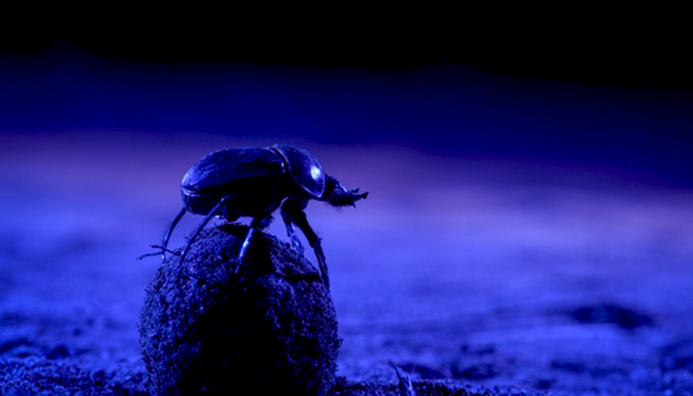
Note. Adapted from Light pollution disorients animals that navigate by the night sky [Photograph], by James Foster, 2021, National Geographic ( https://www.nationalgeographic.com.es/naturaleza/contaminacion-luminica-desorienta-a-animales-que-se-guian-cielo-nocturno_17233# ).
These findings, published in Current Biology, on animals adapted to nighttime darkness, reinforce the theory of the behavior of animals that try to orient themselves using artificial light sources, such as streetlights and others, becoming even more disoriented and sometimes even with fatal effects. The light emitted by humans is a kind of "demagnetizer" of the stellar compass that these nocturnal animals have, which include migratory birds, seals, fish, mammals, amphibians, insects and plants among others.
Because of the damage caused by excessive light, laws have begun to be enacted in different countries around the world to protect the right to the gradual recovery of dark skies and a reduced ecological impact.
3. CONCLUSION
3.1. INTERACTION WITH THE SPECTATOR
The viewer's interaction with these contemporary sculptures makes it possible to visualize several high-level issues, such as:
- Poverty and energy pollution,
- The loss of biodiversity,
- or the preservation of ancient crafts such as weaving, or esparto grass (basketry), among others .
Maintaining these art-craft sculptures through diverse, interconnected dialogues, with the same goal: that the triad of nature, art, and science operate together, responding to a state of human consciousness of respect for the environment in which it subsists, to offer:
- Clean energy to avoid deforestation and protect the soil.
- The defense and regeneration of biodiversity.
- The cultural preservation of ancient rural crafts, which care for and conserve the plants that make up the forest.
Furthermore, the symbolism of solar sculptures not only highlights the energy crisis as a primary economic and political necessity, but also recognizes that light has been used symbolically for centuries in rituals to dispel darkness and find answers to the most abstract ideas, offering a quest for purification, liberation, and peace. This empirical dichotomy develops our inner sensory and emotional perception and has a direct impact on our subconscious. For this reason, light is a highly valued symbolic element within the cultural industry, allowing for an exchange of signs and meanings. Through light, objects symbolize and acquire a meaning beyond their objective equivalence.